The 5W2H method is a widely used framework in problem-solving, quality management, and business analysis. By asking What, Where, When, Why, Who, How, and How Much, we systematically define a problem.
However, there is one particular question in that which often leads to confusion: This question is “Why?”
Understanding the “Why” in 5W2H
At first glance, one might assume that asking “Why?” in 5W2H is the same as performing a root cause analysis. But that’s not the case. The purpose of this question in 5W2H is not to determine why the issue occurred. Instead, it is meant to establish whether the issue is actually a problem in the first place.
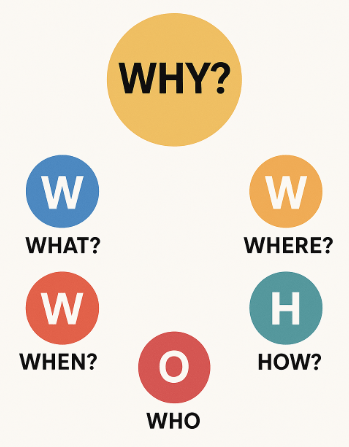
The key function of “Why?” in 5W2H is to validate whether there is a deviation from the expected standard. Instead of asking: “Why did this problem happen?” it asks: “Why is this a problem?” This is very important distinction ensures that resources are not wasted investigating issues that are not actually critical.
Let’s consider a simple manufacturing issue:
Problem: A part is broken. We should ask “Why is this breakage considered a problem?”
Answer: “Because the product requirement states that no breakage is allowed, meaning the part does not meet the specified criteria.”
By first confirming whether something is truly a problem, we prevent unnecessary problem solving efforts.
Conclusion
Misusing “Why” in 5W2H can lead to incorrect assumptions and premature root cause analysis. Before investigating the cause of an issue, it is essential to establish whether it is indeed a problem or not.
The 5W2H method is a powerful tool for problem definition, but only when used correctly. Ensuring that the “Why” question is applied properly allows teams to focus on valid problems before investing time and resources in deeper analysis.
If you want to learn more, you can check out my Udemy course.

 Mete Kilic
Leave a Reply